
TikTok is neither all good nor all bad for children. It offers a creative outlet, entertainment and educational content, alongside an endless feed built to hold attention, harmful content that slips past moderation, and privacy concerns.
The workable approach pairs an honest conversation with a daily time limit, TikTok’s own Family Pairing settings, and a device-level control that holds the limit whichever account a child signs into.
TikTok has become ubiquitous in social media culture, particularly among younger generations. The app lets users create and share short videos set to music, and it has grown fast since its creation in 2016. TikTok reported passing one billion monthly active users in 2021.
It has its fair share of critics, yet plenty of people enjoy it for entertainment, creativity and social connection. The question most parents actually want answered is simpler: is TikTok safe for my child?
Young users value TikTok for the sense of community it creates and the room it gives them to express themselves. The recommendation algorithm makes it easy to find content they enjoy and people who share their interests.
The platform is not without downsides. Addictive design, inappropriate content, privacy concerns and limited regulation are the four that come up most often. Some argue better moderation would fix them; others believe the negatives outweigh the positives. The sections below take each in turn.
TikTok feeds each user a personalized, endless stream of short videos chosen by a recommendation algorithm. The more you watch, the sharper its guesses become.
Open the app and you land on the For You page, a feed built from your interests and your past interactions. It is designed to keep you watching, and it is very good at it. That single design choice explains most of what follows in this article, the good as much as the bad.
The app also provides editing tools: effects, filters and a wide catalogue of music. The duet feature, which places your video side by side with someone else’s, has driven many viral trends.
Unlike platforms built around celebrities, most of what you see on TikTok comes from ordinary users. That is where its sense of community comes from, and it is also why moderation is hard: an enormous volume of new content arrives every day.
TikTok was built by ByteDance, a Chinese technology company founded in 2012 by former Microsoft engineer Zhang Yiming. The app launched in China as Douyin in 2016, then rolled out globally as TikTok. ByteDance has since become one of the world’s most valuable startups, widely reported to be worth well over $100 billion.
Its rise rests largely on the algorithm, which draws on user interactions, video information, and device and account settings. It works well enough that some observers describe TikTok as one of the largest data collection platforms in existence.
The format helped too. Clips of fifteen seconds are easy to consume and easy to share, which suited younger audiences.
Success brought scrutiny. In the US, lawmakers raised concerns about data privacy and national security, some called for a ban over the app’s Chinese ownership, and the company faced several legal challenges over its data practices. That fight is covered further down.
The algorithm is the main reason, and it is covered above. Beyond it, three things keep people coming back.
Making something is easy. Lip-syncing, dancing, editing, adding a soundtrack: the barrier to creating is low enough that viewers become creators. That is unusual among social platforms, where most people only ever watch.
Taking part is built in. Challenges, duets and trends give users a reason to respond rather than only scroll.
The app keeps changing. Live streaming, e-commerce and new formats have been added over the years, so the experience rarely feels stale.
Before the detail, here is what TikTok offers children and where the real dangers lie. Use it as a quick reference when deciding how much access feels right for your family.
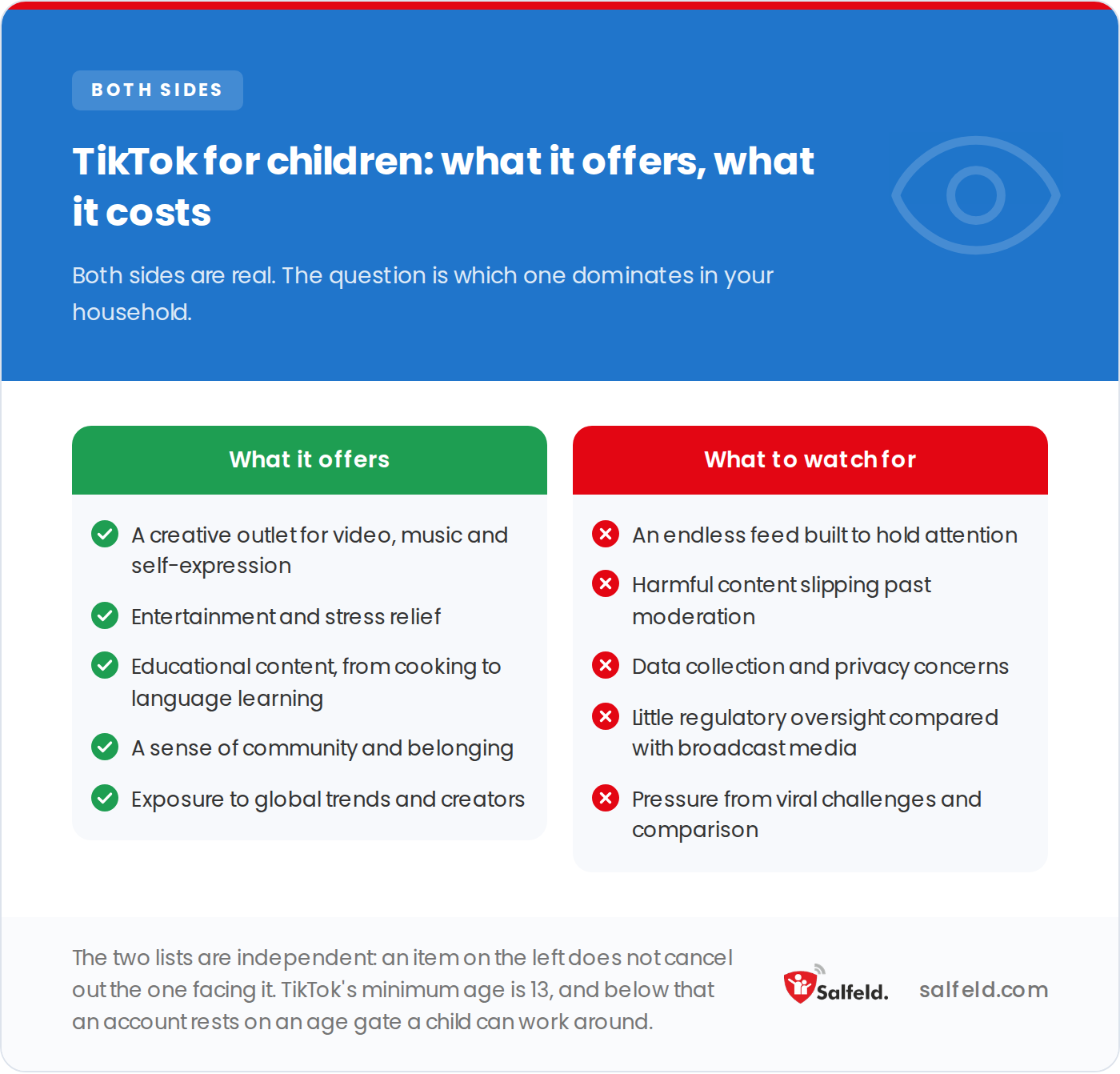
The same points are written out below the image, which is the version screen readers and search engines can read.
What TikTok offers children
What to watch for
The two lists are independent. An item on one side does not cancel out the item facing it on the other.
Four issues come up again and again: addictive design, inappropriate content, privacy and weak regulation. For children, they can outweigh the fun when no adult guardrails are in place.
Addictive design. The algorithm serves an endless stream tailored to your interests. Many users spend hours scrolling, often at the expense of sleep, school or time with other people. That pattern can affect mood, concentration and wellbeing.
Inappropriate content. TikTok’s community guidelines prohibit explicit and violent content, but enforcing them at this scale is difficult. Users regularly report encountering sexually suggestive or violent videos, which can be distressing for younger viewers.
Privacy. In 2020, TikTok was criticized over its data practices and its alleged ties to the Chinese government. The company has since opened transparency centers and added privacy controls. Many users remain skeptical.
Weak regulation. The app is not subject to the oversight that applies to television or newspapers. That gap makes it easier for harmful content to slip through, and harder to hold the platform to account.
Used in moderation, TikTok offers four things worth naming.
Entertainment. Short-form video, from comedy sketches to dance challenges, is easy to dip into and genuinely enjoyable.
Creativity. The editing tools and the music catalogue let users make something of their own: original songs, dance routines, visual art. For some children this is the first place they publish anything.
Learning. There are videos that teach cooking techniques, financial basics and languages. Some teachers use the format to reach students who tune out in class.
Connection. Because the algorithm surfaces content by interest, children often find people who share theirs, and can interact with creators directly.
No. TikTok is available in the US, and the ownership fight that drove years of ban threats was settled at the start of 2026. The outcome was not a ban but a forced change of owner.
The short version of a long saga. A 2020 attempt to push TikTok out of the US was blocked in court, and the debate then shifted from banning the app to changing who controls it.
In April 2024, Congress passed the Protecting Americans from Foreign Adversary Controlled Applications Act (PAFACA), which required ByteDance to sell TikTok’s US operations or see the app pulled from US app stores. The Supreme Court upheld that law in January 2025, and enforcement was delayed repeatedly through 2025 while a sale was negotiated.
On January 22, 2026, the deal closed. TikTok’s US operations were divested into a new, US-controlled joint venture called TikTok USDS, led by Oracle, Silver Lake and MGX, with ByteDance keeping a minority stake under 20 percent.
The concern behind all of this was that ByteDance’s Chinese ownership could expose US user data, or let the app be used for influence. The new structure puts US user data and the recommendation algorithm under American control.
For parents, the practical takeaway has not changed: whoever owns TikTok, the day-to-day questions of screen time and content are yours to manage.
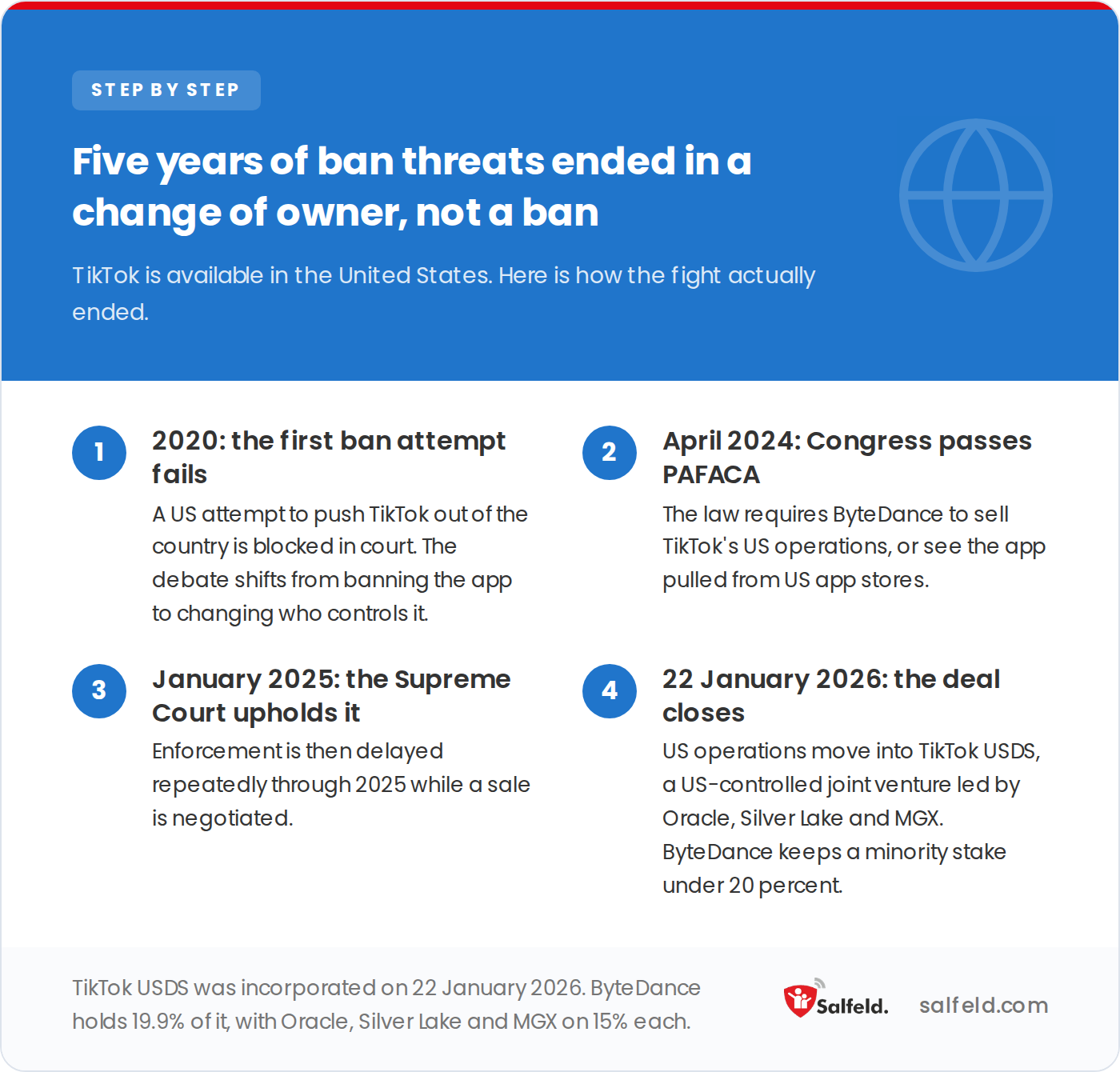
Dates matter here: articles written before January 2026 still describe a ban that never happened.
The concerns above are real, and there are practical ways to reduce them. One is parental control software that works at the level of the device rather than inside the app. See our guide to Salfeld Child Control for the full picture.
Salfeld Child Control runs on Android and Windows. Parents can set a time limit on individual apps, including TikTok, so an evening does not disappear into the feed. The same software blocks access to inappropriate content and restricts specific websites, which matters because a child who hits the TikTok limit usually opens something else.
TikTok is not the only app worth setting up carefully. If your teen also uses Snapchat, our guide to Snapchat parental controls walks through Family Center and the settings that matter.
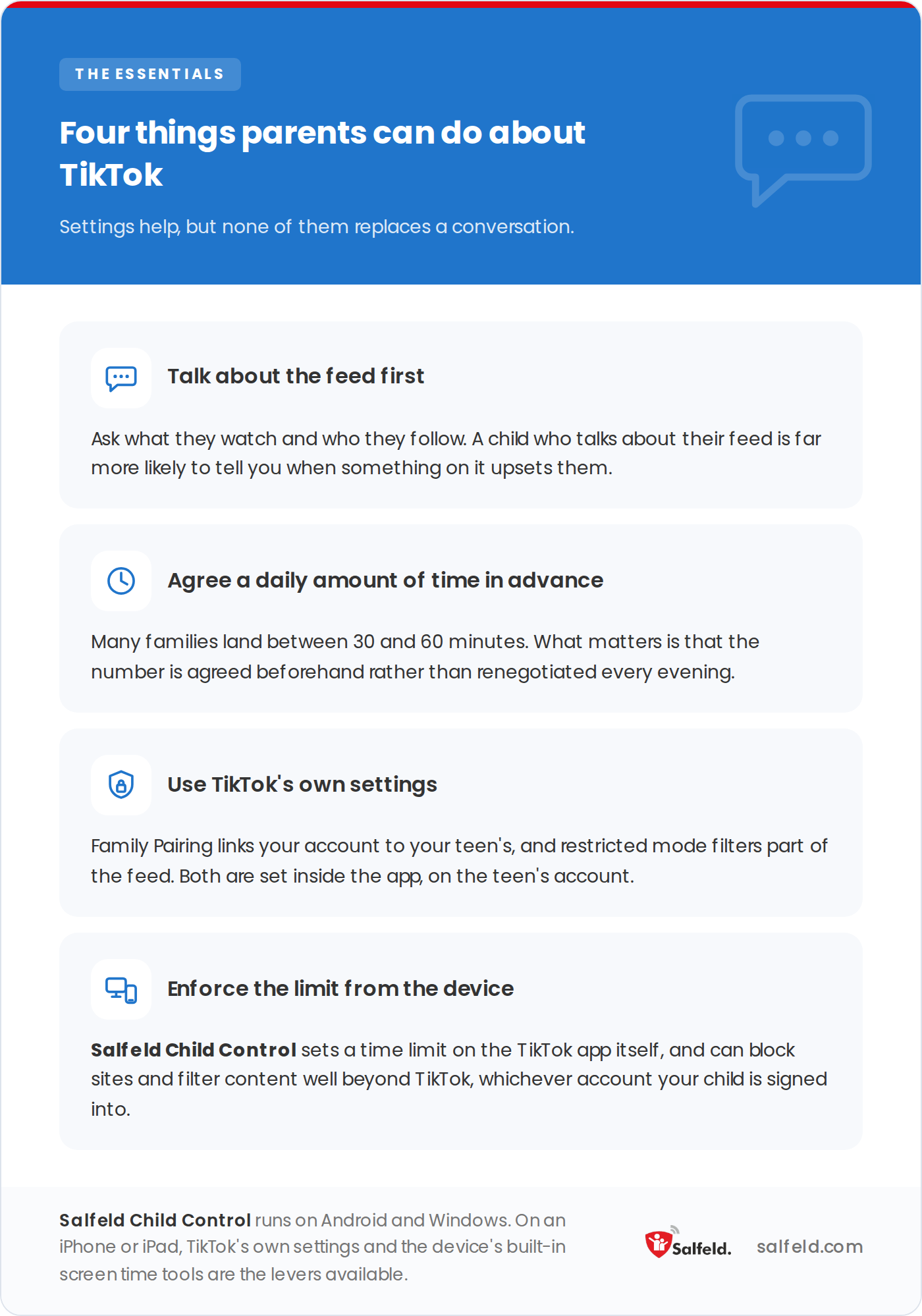
The first of the four costs nothing and works on every device, including the iPhone.
TikTok requires users to be at least 13 years old, and it offers a separate, restricted experience for younger users in some regions. Younger children can still find ways around age gates, so parental supervision and device-level controls remain important for kids under 13.
TikTok can be reasonably safe for older children when parents use Family Pairing, restricted mode, screen-time limits, and open conversations. The main risks are inappropriate content, addictive design, and privacy concerns. Younger kids need closer supervision or a locked-down account to stay protected.
There is no single correct number, but many experts suggest keeping recreational screen time modest and balanced with sleep, school, and offline activity. Setting a daily TikTok limit, for example 30 to 60 minutes, and enforcing it with parental control software helps prevent the endless-scroll habit.
No. TikTok is available in the US. A 2024 law required ByteDance to sell TikTok’s US operations, the Supreme Court upheld that law in January 2025, and the sale closed on 22 January 2026. US operations now sit in TikTok USDS, a US-controlled joint venture, with ByteDance holding a minority stake under 20 percent.
This article rests on figures and decisions with a date attached, which may have moved on by the time you read it. If something here looks out of date or wrong, tell us and we will correct it.