
This guide skips the general advice about online safety. It gives three concrete things: the exact sentence to say to your child at each age from 6 to 15 and up; the four situations that actually happen, with the observable sign and the first move to make; and who to contact in each case, in the UK and the US.
It also sets out what backfires, meaning the parental reflexes that feel protective in the moment but guarantee a teenager says nothing next time.

Most online safety guides say the same three things: talk to your child, set rules, install a parental control. All true, and all useless on a Tuesday evening when your eleven-year-old refuses to go to school and will not say why.
This guide starts from the other end. It gives you the sentence to say, the sign to watch for, and the number to call.
The short version
Say the right sentence at the right age: the secret rule at 6, the permanence of a photo at 9, the group chat at 12, image blackmail at 15.
When something happens, always start with “you have done nothing wrong”, save the evidence before blocking anything, then report it.
Under-18s can get an intimate image taken down through Report Remove in the UK or Take It Down in the US, without an adult ever seeing it.
A six-year-old and a fifteen-year-old do not face the same risks, and they do not retain the same sentences. The common mistake is one big conversation, held too early or too late, and never revisited.
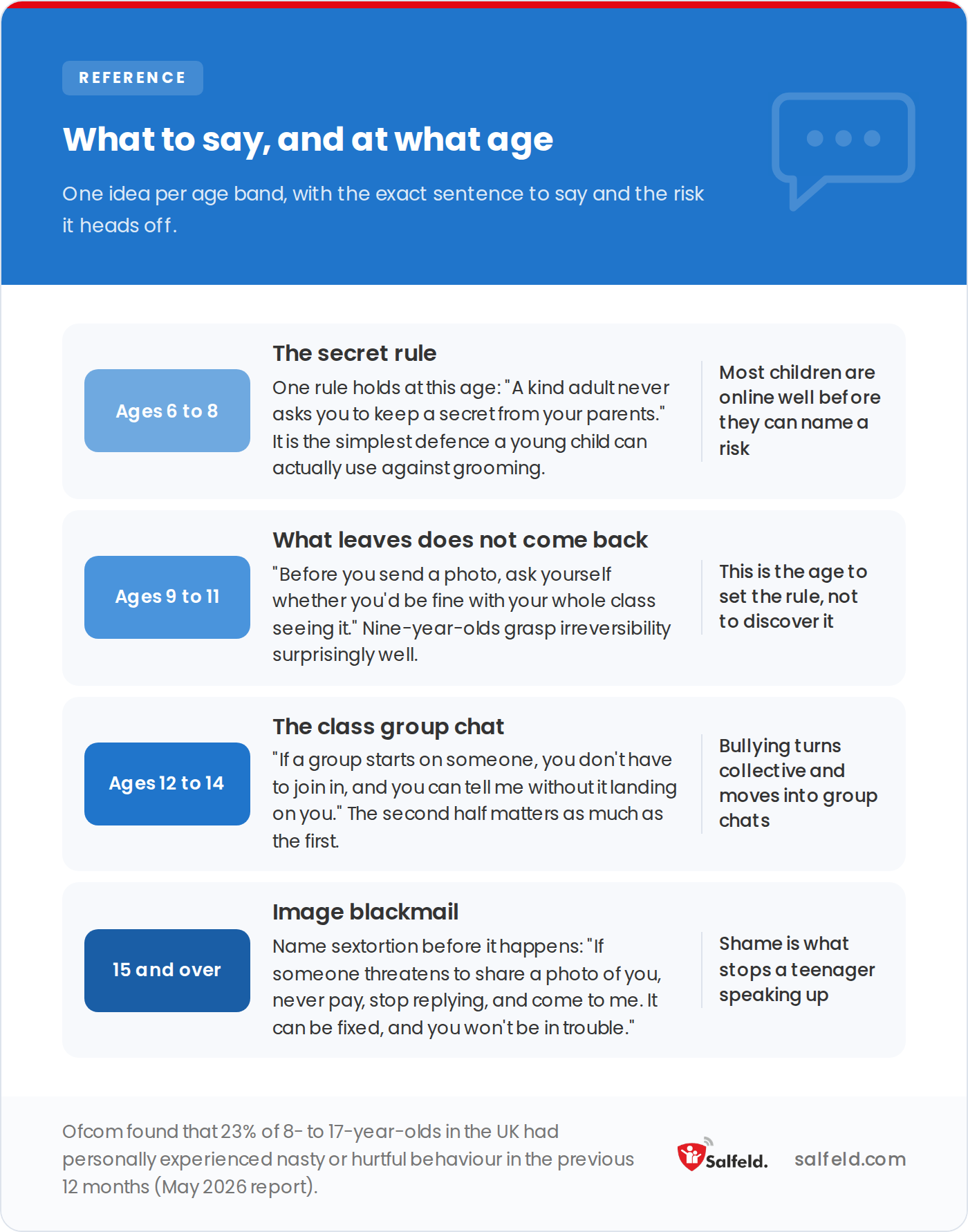
Each age band comes down to one idea. Repeated twice a year, it beats an annual lecture.
At this age one rule holds, and it protects against grooming better than any other:
“A kind adult never asks you to keep a secret from your parents.”
It is short, it sticks, and it gives a child a test they can apply without understanding what a predator is. Ofcom found that 33% of 8- to 17-year-olds in the UK had encountered content they found worrying or nasty in the past year, so the conversation needs to start well before secondary school.
The idea of irreversibility lands well around nine. The simplest test:
“Before you send a photo, ask yourself whether you’d be fine with your whole class seeing it.”
This is also the moment for the rule about details that locate a person: less the name than the school, the club, the finishing time, or a photo taken outside the front door.
Bullying changes shape at secondary school. It turns collective, and it moves into group messaging, where the audience is the whole class and the evidence disappears fast.
“If a group starts on someone, you don’t have to join in, and you can tell me without it landing on you.”
The second half of that sentence matters as much as the first. A teenager who expects to lose their phone for speaking up will not speak up.
Sextortion has to be named before it happens, because once a teenager is in it, shame does the rest. The IWF has reported a rise in financially motivated sexual extortion, where organised groups target young people to obtain images and then blackmail them.
“If someone threatens to share a photo of you, never pay, stop replying, and come to me. It can be fixed, and you won’t be in trouble.”
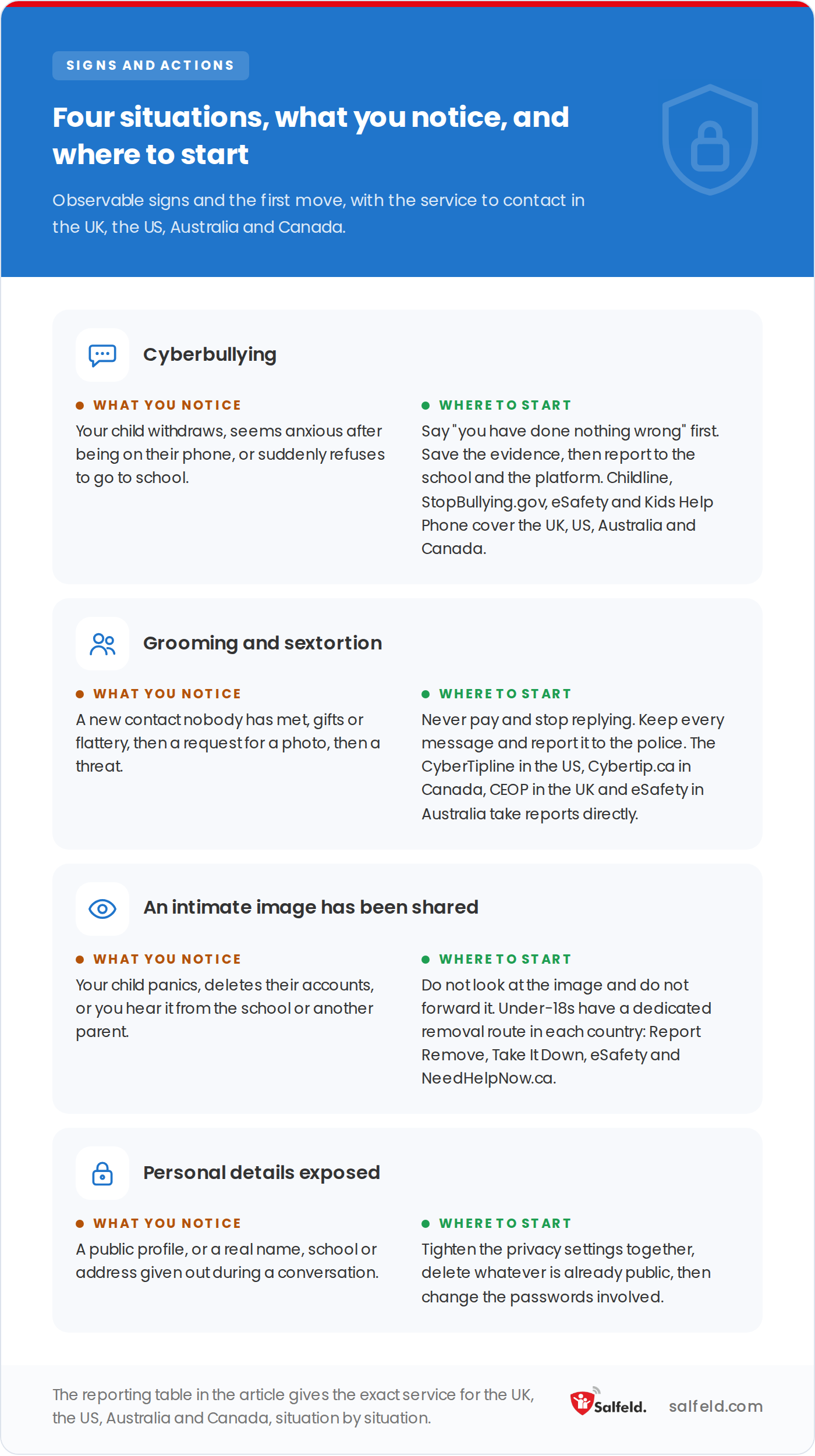
Grooming is the only one of the four where the first call goes to the police, before the school or the platform.
Cyberbullying. Your child withdraws, seems anxious after being on their phone, or suddenly refuses to go to school. Start by telling them they have done nothing wrong, save the evidence, then report it to the school and the platform.
Grooming and sextortion. The pattern is almost always the same: a new contact nobody has met, gifts or flattery, a request for a photo, then a threat. Never pay, stop replying, keep every message, and report it to the police.
An intimate image has been shared. Do not look at the image and do not forward it, not even to report it. There is a dedicated route for this, described below, and your child can use it themselves.
Personal details exposed. Tighten the privacy settings together, delete whatever is already public, then change the passwords involved.
This is the question parents ask most, and almost no guide answers precisely. Here is the route for each situation.
| Situation | Who to contact | How |
|---|---|---|
| Cyberbullying, UK | Childline | 0800 1111, free and confidential, or online chat |
| Cyberbullying, US | The school, the platform, and StopBullying.gov | Official guidance on how and where to report |
| Cyberbullying, Australia | eSafety Commissioner | Reports cyberbullying of a child, and can direct removal |
| Cyberbullying, Canada | Kids Help Phone | 1-800-668-6868, or text CONNECT to 686868, 24/7 |
| Intimate image of an under-18, UK | Report Remove, by Childline and the IWF | The child reports it themselves; an IWF analyst assesses it |
| Intimate image of an under-18, US | Take It Down, by NCMEC | Assigns the image a hash so platforms can block it |
| Intimate image of an under-18, Australia | eSafety Commissioner, image-based abuse | Can direct the removal of the image |
| Intimate image of an under-18, Canada | NeedHelpNow.ca, by the Canadian Centre for Child Protection | Step-by-step help to stop the spread |
| Grooming or sexual exploitation, US | CyberTipline, run by NCMEC | Reports go to law enforcement |
| Grooming or sexual exploitation, UK | The police, and CEOP | Call 999 if there is immediate danger |
| Grooming or sexual exploitation, Canada | Cybertip.ca | Referred to police and child welfare services |
| Grooming or sexual exploitation, Australia | The police, and the eSafety Commissioner | Call 000 if there is immediate danger |
| Intimate image of an adult | StopNCII.org | For over-18s, outside the child protection route |
Two of these are worth knowing before you need them. eSafety in Australia is unusual in that it is a government regulator with the power to direct a platform to remove content, rather than a charity that asks. Cybertip.ca forwards reports to the police and to child welfare services, and its parent organisation also runs Project Arachnid, which crawls the web for known abuse images and flags them for takedown.
Report Remove is worth knowing about before you need it. A young person under 18 reports the image themselves, the Internet Watch Foundation reviews it and gives it a digital fingerprint so it can be spotted and removed across the internet, and Childline keeps them updated throughout. Crucially, a parent never has to view the image, and neither does anyone else outside the IWF.
One limit to know: the IWF can act on images that are publicly available online. It cannot remove something sitting inside an encrypted chat or saved on someone’s phone.
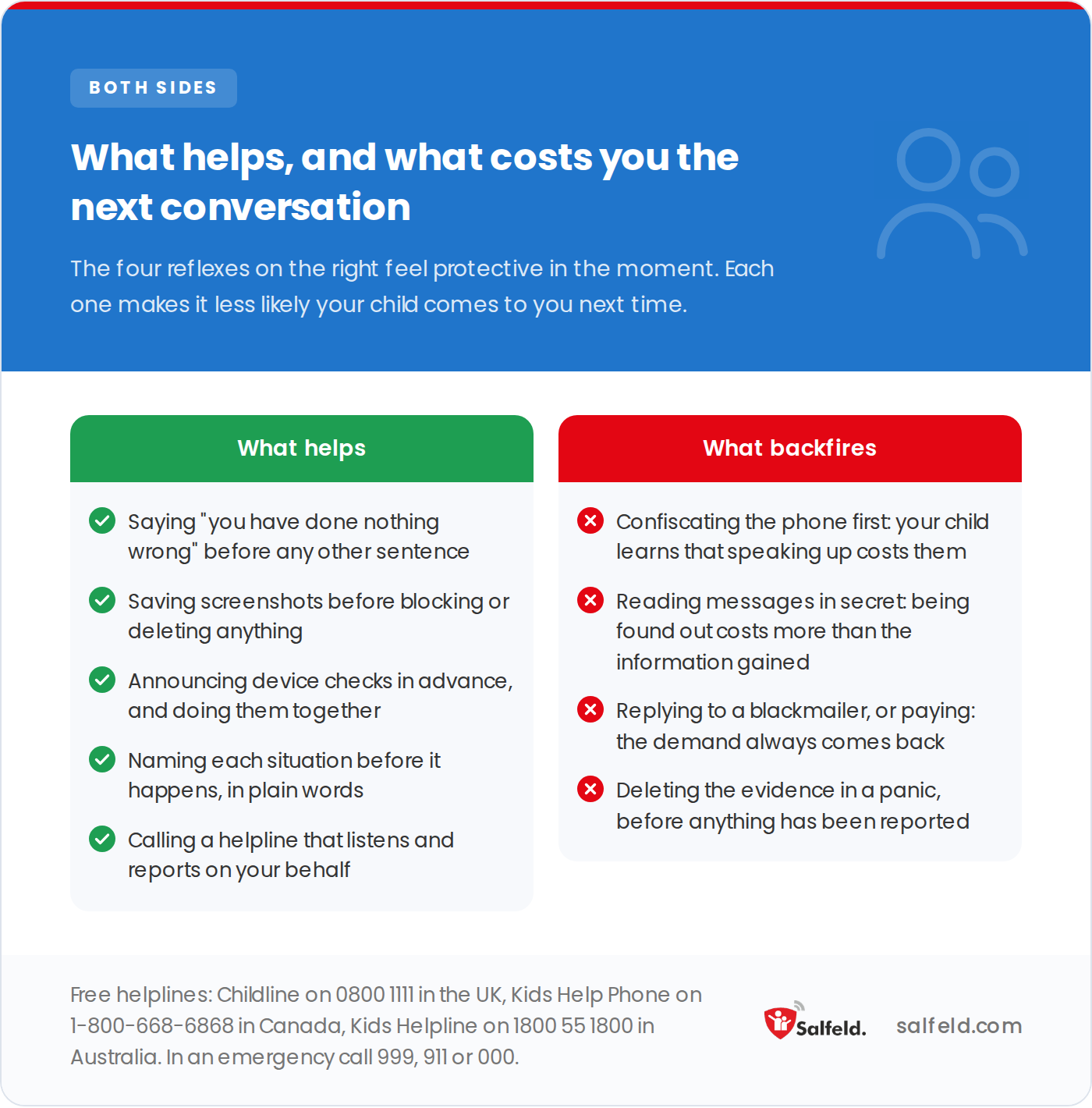
The four reflexes on the right are the most common ones, and the most expensive.
Four reactions feel protective in the moment and cost you later.
Confiscating the phone first. It is the most natural response, and it is the single biggest reason a teenager says nothing. They learn that speaking up gets them punished.
Reading messages in secret. You may gain a piece of information. You lose the chance that they come to you on their own, and they always find out eventually.
Replying to a blackmailer, or paying. The demand comes back every time. A payment proves the threat works.
Deleting evidence in a panic. Blocking and deleting brings relief, but a report or a police complaint without screenshots moves far more slowly.
Disclosure: Salfeld makes Salfeld Child Control, a parental control app, and publishes this blog. Here is an honest account of what a tool like that changes, and what it does not.
A control installed on the device sets time limits per app, blocks access during set hours, and filters sites by category or age. Because it sits on the device, it keeps applying whichever account your child signs into. Salfeld Child Control runs on Windows and Android.
What no software does: recognise manipulation that starts with compliments, spot a threat made in half-words, or make a child come and talk to you. The four situations above are resolved by a conversation and a report, not by a setting.
A tool sets the frame and reduces exposure. It replaces neither the sentences in the first section nor the phone numbers in the third.
From the first connected device, often between 6 and 8, with a single rule: a kind adult never asks a child to keep a secret from their parents. The message then grows in stages, the permanence of a photo around 9, group chats around 12, and image blackmail around 15.
Tell them they have done nothing wrong, before any other sentence. Then save the evidence as screenshots, before blocking or deleting anything. Report it to the school and to the platform. In the UK, Childline is free and confidential on 0800 1111. In the US, StopBullying.gov sets out how and where to report. In Australia, the eSafety Commissioner can direct a platform to remove the content. In Canada, Kids Help Phone answers on 1-800-668-6868, day and night.
In the UK, an under-18 can use Report Remove, run by Childline and the Internet Watch Foundation: the young person reports the image themselves, an IWF analyst assesses it, and it is given a digital fingerprint so it can be blocked across sites. In the US, NCMEC’s Take It Down service does the same through hashing. In Australia the eSafety Commissioner can direct its removal, and in Canada NeedHelpNow.ca walks a young person through the steps. Do not view or forward the image yourself.
A check announced in advance and done together is supervision. The same check done in secret is surveillance, and its cost almost always exceeds its benefit: your child eventually finds out and stops talking to you. Agree the principle before you hand the device over.
No. Software sets time limits, blocks apps during set hours and filters sites. It does not recognise manipulation, does not detect a threat made in half-words, and does not make a child speak up. It complements the conversations described above; it does not replace them.
Pages retrieved on 12 August 2026.
This article offers practical guidance and official points of contact. It is not medical or legal advice. If a child is in immediate danger, call 999 in the UK, 911 in the US and Canada, or 000 in Australia.
The helplines, reporting services and procedures listed here can change, and we re-check them regularly. If one of them has moved, or if anything here is wrong, tell us and we will correct it.